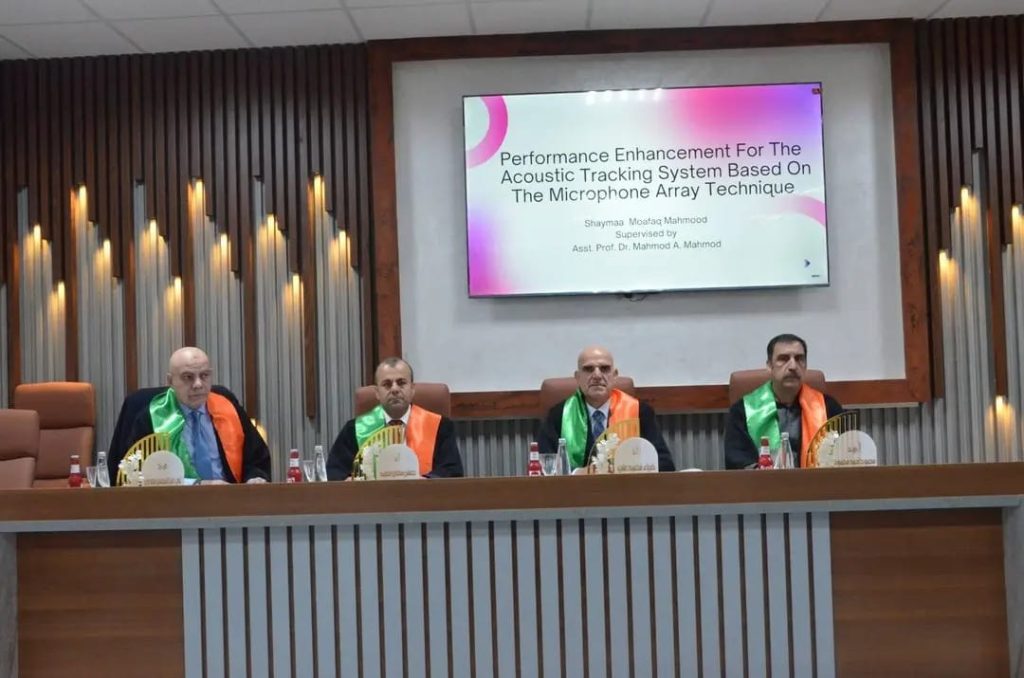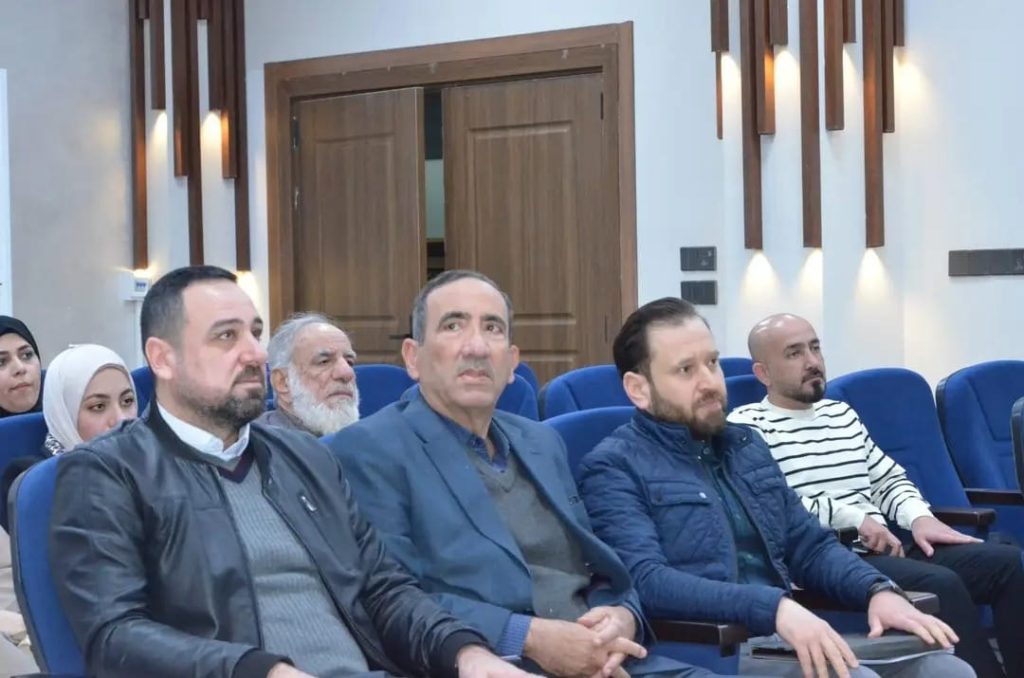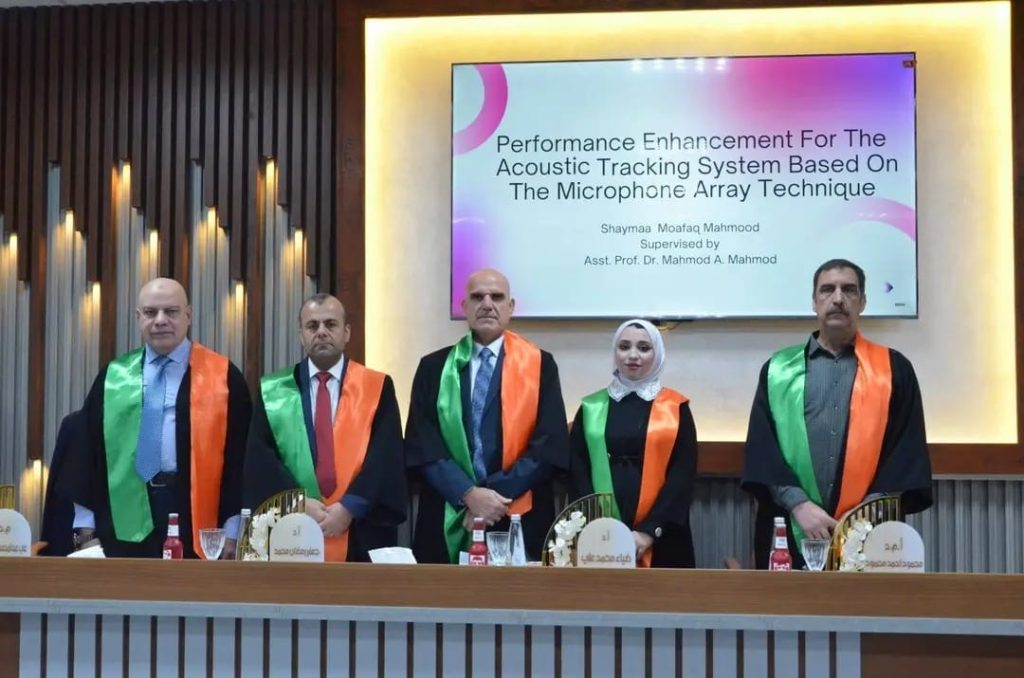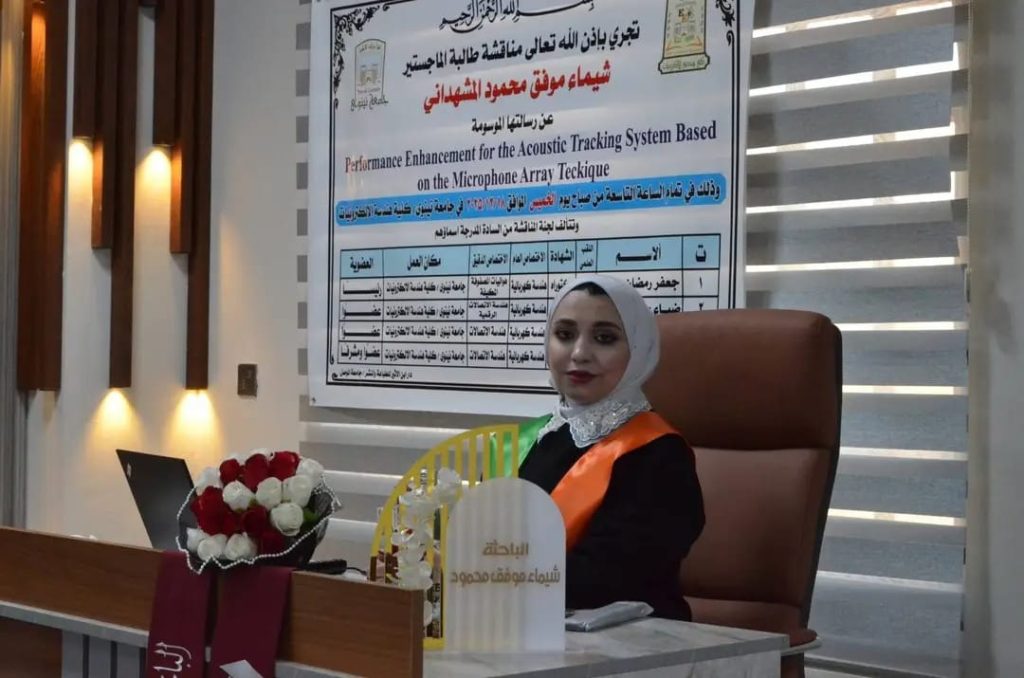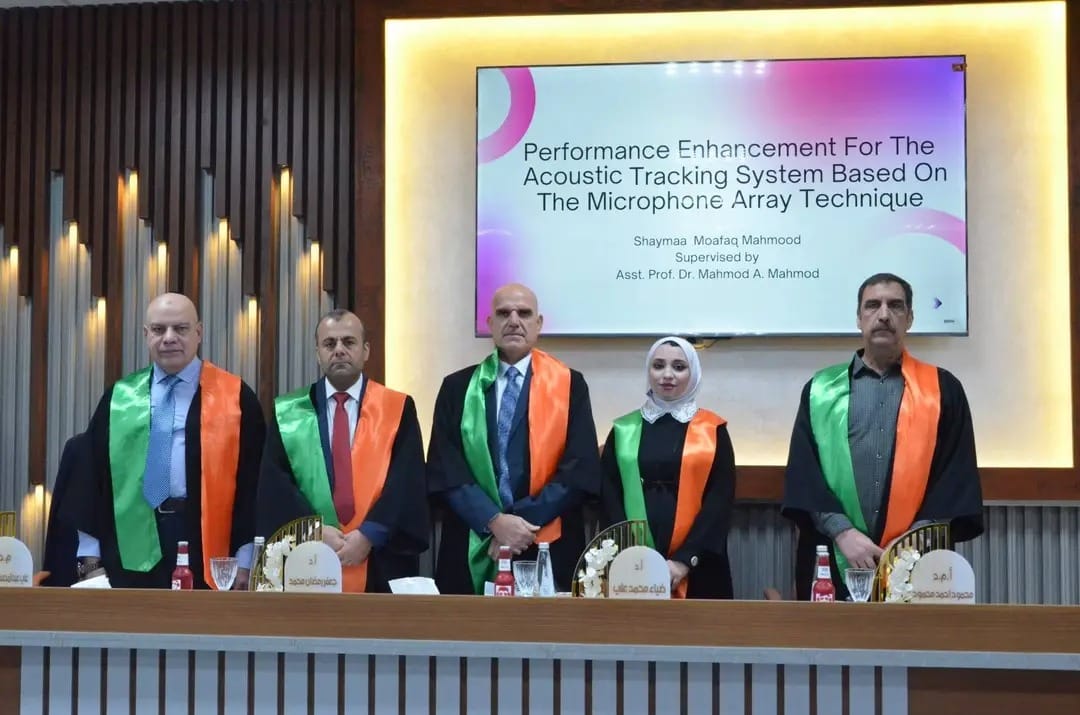
The College of Electronics Engineering at the University of Ninevah / Department of Communication Engineering discussed, on Thursday (18/12/2025), the Master’s thesis submitted by the student Shaimaa Muwaffaq Mahmoud, entitled:
“Performance Enhancement for an Acoustic Tracking System Based on the Microphone Array Technique.”
The thesis addressed the design of an acoustic tracking system based on the Lobe Switching tracking technique, which requires an electronic beam scanning system relying on a microphone array. The beam scanning system was designed using 85 microphones arranged in a regular geometric configuration within the proposed structure. Amplitude excitation based on the Binomial Distribution technique was employed to achieve a radiation beam scanning system characterized by the absence of sidelobe components.
The proposed beam scanning system successfully covered a scanning range from 30° to 150°, with 2° increments and a scanning sector of 20° for each case. This system played a fundamental role in developing the acoustic tracking system using MATLAB software. Artificial intelligence techniques were utilized to calculate the array element coefficients in order to achieve symmetry on both sides of the main lobes and to unify the Half-Power Beamwidth (HPBW) across different angles.
The acoustic tracking system demonstrated a high capability for accurate tracking and a significant reduction in error, with deviation from the center of the scanning region approaching zero percent, in contrast to the errors observed when 57 microphones were used in previous work. This improvement is attributed to the enhanced symmetry between the two sides of the scanning lobes, resulting from the application of amplitude excitation in implementing the beam scanning system. In addition, constant HPBW values of 22° were achieved across all cases. Accordingly, this work represents a substantial improvement in acoustic tracking systems based on microphone arrays employing amplitude excitation.
The discussion committee consisted of:
• Prof. Dr. Jaafar Ramadan Mohammed / University of Ninevah/ College of Electronics Engineering (Chairman)
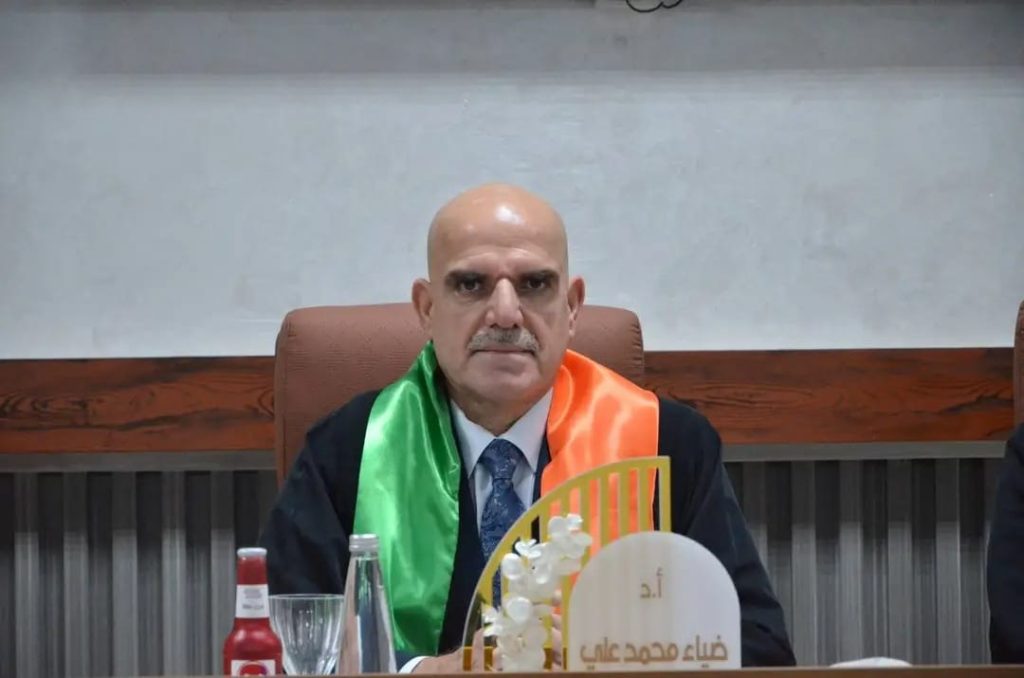
• Prof. Dr. Diaa Mohammed Ali / University of Ninevah / College of Electronics Engineering (Member)
• Asst. Prof. Dr. Ali Abdulmuhsin Saadoun / University of Ninevah/ College of Electronics Engineering (Member)
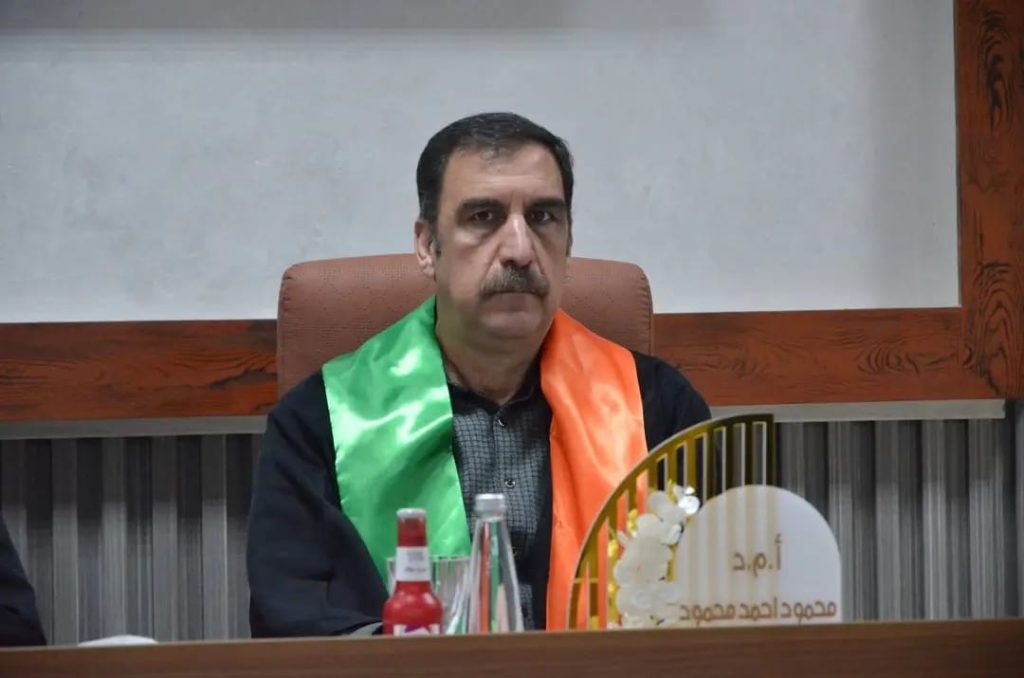
• Asst. Prof. Dr. Mahmoud Ahmed Mahmoud / University of Ninevah / College of Electronics Engineering (Member and Supervisor)
Part of the discussion was attended by the Dean of the College of Electronics Engineering, Prof. Dr. Khalid Khalil Mohammed.
We extend our best wishes to the student and the examination committee for continued success and achievement.