
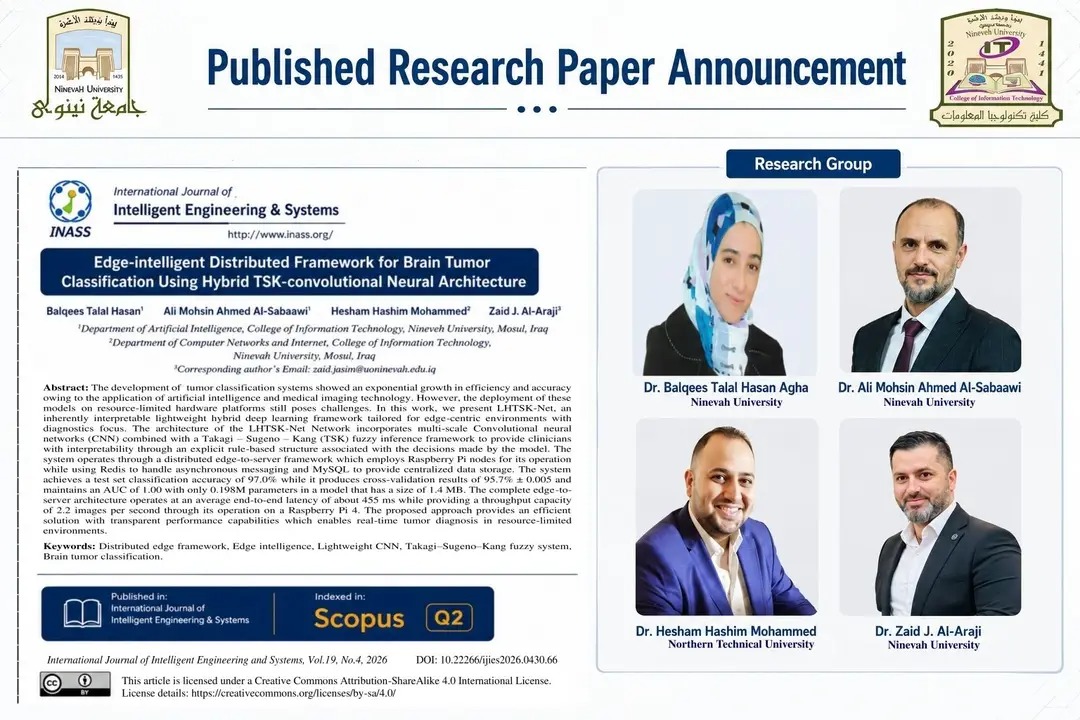
The College of Information Technology at the University of Ninevah has continued to strengthen its international research standing through the publication of a scientific paper in the International Journal of Intelligent Engineering and Systems, a journal indexed in the Scopus database and ranked within the second quartile (Q2).
This achievement is the result of scientific collaboration between researchers from the College of Information Technology at the University of Ninevah and the Northern Technical University. The published paper is entitled:
“Edge-intelligent Distributed Framework for Brain Tumor Classification Using Hybrid TSK-convolutional Neural Architecture.”
The research focuses on developing an intelligent distributed framework based on Magnetic Resonance Imaging (MRI) scans for the diagnosis and classification of brain tumors by integrating deep learning techniques with distributed computing. This provides accurate, rapid, and practical medical solutions for modern healthcare environments.
The study emphasizes the integration of artificial intelligence with distributed systems. The research team adopted an Edge Computing architecture that performs analytical processes on low-cost devices such as the Raspberry Pi and connects them to central servers through an intelligent communication network. This architecture achieved a classification accuracy of 97% while significantly reducing response time.
The research also relied on a hybrid algorithm combining Convolutional Neural Networks (CNN) with TSK Fuzzy Logic to enhance diagnostic accuracy and improve the interpretability of results, representing a step toward building more reliable and transparent AI-based medical systems. The model was distinguished by its lightweight design, with a size not exceeding 1.4 MB, making it ideal for resource-constrained devices and smart healthcare systems based on edge computing.
The research team included:
- Assistant Lecturer Dr. Balqees Talal Hassan Agha – Department of Artificial Intelligence, College of Information Technology.
- Assistant Lecturer Dr. Ali Mohsen Ahmed Al-Sabawi – Head of the Software Department, College of Information Technology.
- Associate Professor Dr. Hisham Hashim Mohammed – Assistant Dean for Scientific Affairs and Postgraduate Studies, Technical Agricultural College, Northern Technical University.
- Dr. Zaid Jassim Al-Araji – Department of Computer Networks and Internet, College of Information Technology.
This achievement represents a valuable addition to the record of the College of Information Technology and an advanced step in the field of intelligent medical systems based on artificial intelligence and distributed computing. It also stands as a distinguished example of scientific collaboration between academic institutions in leading computer science disciplines.
Research link in the Scopus repository:
Scopus Research Page